First Colony
The Passage (Justin Cronin Edition)First Colony is a walled settlement in the San Jacinto Mountains of the California Republic, founded as an ark-like refuge for children evacuated from the collapsing old world. Its lights and walls promise safety from the infected, but its defining image is also one of loss: when the gates close and the lights come on, they blot out the stars, and the survivors begin a life from which the old world’s people and even its night sky seem permanently absent.
Founding and First Night
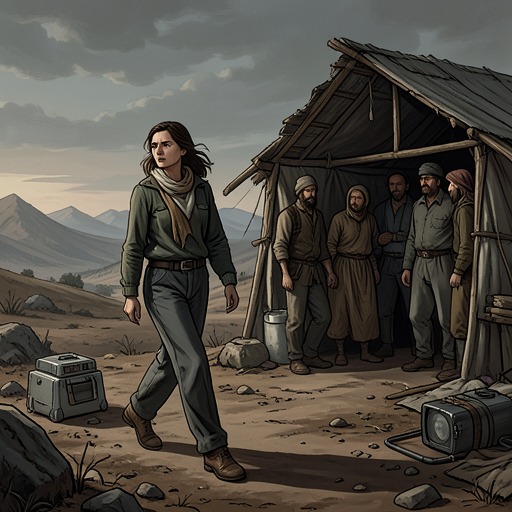
The first arrivals reach the settlement by bus after a journey from a desert evacuation site. The change announces itself before the place is fully visible: the air is fresh and cold, and the children shiver as soldiers lead them past the walls and the tall light poles. The surrounding supply operation is extensive. Army personnel and FEMA trucks bring food, guns, clothing, toilet paper, and livestock, including sheep, goats, horses, chickens, and dogs. The settlement is not simply a shelter discovered in the wilderness; it is a place being provisioned and organized to hold a population.
The Watchers arrange the newcomers in lines, record their names, provide clean clothes, and take them into the Sanctuary. There, Ida Jaxon and Terrence Jaxon are placed in the room where the Littles still sleep generations later. Terrence, whose father helped build the train that carried children to safety, explains the place to Ida as their new home: the lights and walls will keep them safe, like Noah’s ark. He cannot promise that they will see their parents again, but he renews his promise to look after her. His words give the settlement both its practical purpose and its founding story: protection is necessary, while return to the former life is uncertain.
The Watchers tell the children that the Army will return with more children and soldiers, but it does not. The buses and trucks leave; as darkness falls, the gates are sealed. Ida and Terrence stand outside together in the cold as the lights blaze across the settlement, bright enough to erase the stars from view. This is First Night, the moment the survivors understand that they will live there from then on. Ida recalls that she has never seen those stars again.
People and the Making of a Community
First Colony’s first residents do not arrive as an already unified society. They are displaced children, separated from families and brought together through evacuation. Terrence’s promise to Ida becomes an early act of care in a place where adults cannot answer whether the children will ever see their parents again. He extends the same offer to Lucy Fisher, who is crying beside her brother Rex, and agrees to look after them too. Lucy later becomes Terrence’s wife, while Ida remembers her as her closest friend. Their first meeting connects families whose ties continue through later generations: Fishers and Jaxons remain intertwined.
Ida’s recollection also makes the settlement’s history a matter of personal memory rather than only institutional beginnings. She remembers the First Ones who lived through the arrival, including Terrence, who was taken up at twenty-seven, and Lucy, who died in childbirth not long afterward. She recalls other losses as well, and the people whose deaths by their own hands remain especially difficult for her to think about. By the time she tells this history, few remember the first generation by name; she is known as Auntie, a name associated with her childlessness and the many people she carries in memory. First Colony’s continuity is therefore not only in its walls, but in the testimony of those who preserve the names and relationships that its later inhabitants might otherwise lose.
Layout, Work, and Daily Life
Long after its founding, First Colony is a working landscape of houses, fields, animal pens, greenhouses, gathering spaces, and defensive structures. From the Wall, Peter Jaxon can picture the settlement in three dimensions. The Long Path runs from the gate toward Old Town, passing the Armory and West Glade, where Auntie lives. Beyond are cultivated fields of corn and beans, with workers bent over the soil. The Sunspot, a broad semicircular plaza, serves as the place for trading days and open meetings of the Household.
The Sanctuary remains a distinct part of this civic geography. Its bell tower, bricked-in windows, concertina wire, and barricades make it visibly fortified, yet they do not silence the Littles playing in its courtyard. Nearby, pens, barns, grazing fields, and coops hold the animals on which the settlement depends. Three greenhouses provide another cultivated space, their interiors clouded by humidity. Beside them, the Storehouse holds scavenged clothes, tools, food, and fuel, with Walter Fisher presiding over its stalls. These places reveal a community shaped by the need to produce, preserve, distribute, and defend necessities within the walls.
The settlement also bears the uneven passage of time. Some cabins are crumbling and abandoned; Peter’s house has been occupied continuously since the Day. The orchard, apiary, and old trailer park remain as features of the landscape, though nobody lives in the trailer park anymore. The Colony is not static or uniformly maintained: its inhabited center exists alongside structures and areas left behind by successive changes in its population and use.
The Wall, Lights, and the Settlement’s Meaning
The Wall is both a defensive perimeter and a vantage point from which First Colony’s scale becomes legible. On the sixty-third day of summer, Peter stands on Firing Platform One, one of fifteen platforms along the Wall’s catwalk. The platform is usually reserved for Soo Ramirez, First Captain of the Watch, but Peter has occupied it alone for six nights. Its steel net, high light assembly, and crane and tackle make the defensive architecture tangible; the crane is ready to lower him to the Wall’s base if his brother returns. The place that keeps danger outside is also where Peter waits for someone he hopes will come back.
At night the settlement’s twelve light assemblies, each raised above the Wall, transform darkness into a protected interior. At its founding, that illumination was so bright it blotted out the stars. The same lights that signify safety therefore mark a separation: they secure the survivors against what lies beyond the gates, while cutting them off from the old sky Ida remembers. Across the years, First Colony becomes at once a refuge, a community built through care and labor, and a bounded world whose safety is inseparable from its enclosure.